
A Life of Work, Faith, and Endurance
The Story of Jerrold Hogue
Some people clock in. Jerrold Hogue shows up. There is a difference, and over the course of more than fifty years at Navajo Mine, that difference has never been more apparent. He is not a man who talks about himself easily — at a luncheon celebrating his 50th anniversary with the company, others spoke on his behalf, and he listened quietly, genuinely surprised by the words people offered. That, too, tells you something about him.
Roots: Farmington, the Farm, and Family
Jerrold Hogue was born in Farmington, New Mexico, into a Navajo family rooted in the land. His father hails from Burnham; his mother from Waterflow. He is born of the Waterflows Together and Bear clans — Diné through and through. He was the third of seven children, raised in a household where the lessons were practical and the values were clear.
His father was a coal miner — working in Rico, Colorado, then Dove Creek at a uranium mine, and eventually at Navajo Mine itself. He was the sole provider for the family. His mother kept the home. Together they raised seven children on a farm that demanded daily work and daily commitment. That farm was passed down to Jerrold and his family, who continue to maintain it today.
Jerrold attended Nenahnezad School in New Mexico for kindergarten, then elementary school in Brigham City, Utah, and went on to graduate from Box Elder High School. He played defensive tackle his freshman year and ran cross-country track his sophomore and junior years. When the time came to consider his next steps, he did not look far. His father had worked the mine. The mine was close to home. It paid well. He applied.
Fifty Years at the Mine
Jerrold began his career at Navajo Mine — then operating as Utah International — in 1974 as a laborer. To secure a longer-term position with the company, he applied for a truck driving role and was hired. In those early years, he hauled coal and ash without air conditioning, in equipment that bore little resemblance to what operators run today.
Over time, he moved from truck driving to heavy equipment — graders, dozers — and eventually became a loader operator. He worked down in the pit, loading haul trucks with the precision and patience that the job demands. Later, he transitioned to loading trains, operating a Letourneau loader in one of the most demanding roles on the mine site.
At one point, the company asked Jerrold to take on a foreman’s role. He tried it. He did not like it. He went back to being an operator — not out of inability, but out of integrity. He knew where he did his best work, and he returned to it without complaint or regret. That, too, is a kind of wisdom.
He has watched the industry transform across five decades — from equipment without air conditioning or remote controls to sophisticated, technology-driven machinery. He witnessed the arrival of MSHA oversight, the introduction of dust sampling, hearing protection, and respiratory standards. Through every change in ownership — Utah International, BHP, and beyond — Jerrold remained. His advice to anyone in the industry: be honest about your work hours, do the best you can, and work well with whoever you work for.
Today, Jerrold Hogue continues to work as a loader operator at Navajo Mine — the same mine where his father once worked, on the same Navajo Nation land he has called home his entire life.
Family: The Center of Everything
Jerrold has been married for 51 years. He and his wife raised five children together, and he is now the proud grandfather of thirteen grandchildren and great-grandfather to two. He speaks of his family not with sentimentality, but with gratitude — grateful for a steady job that let him provide without struggle, grateful for a family that has stayed close, and grateful for the values his own parents instilled in him.
The most vivid expression of that family bond may be the St. George Marathon. Jerrold has run it 42 times — and this year will mark his 43rd. He wears the St. George Marathon logo on his hard hat at work. His children began running alongside him when they were around ten years old. Now his grandchildren run too. What started as a personal athletic pursuit became, over the decades, a kind of annual family reunion held on open roads.
The Athlete: A Body in Motion for Five Decades
To understand Jerrold Hogue, you have to understand what he has done with his body outside of work. The list is remarkable.
He has run approximately 39 Shiprock Marathons, 4 Duke City Marathons (Albuquerque), 3 Salt Lake Deseret News Marathons, 2 Bears Ears Marathons in Blanding, Utah, and 42 St. George Marathons — with number 43 on the horizon.
He competed in triathlons in Farmington during Fourth of July events, in Shiprock, and in Blanding. Roughly 35 years ago, he completed an Ironman event in San Antonio, Texas.
He used to run or bike approximately 20 miles to work. On his 40th birthday — a Saturday, when the mine was quiet and the roads were empty — he ran 40 miles: from his home to the mine and back. No fanfare. No crowd. Just a man marking a milestone the only way that made sense to him.
He still works out regularly to stay in shape for running. He bikes — mostly mountain biking — and tends his farm. Good health, he will tell you, is not an accident. It is a practice.
A Moment on the World Stage
In 2008, BHP sent Jerrold Hogue to Beijing, China, where he served as an Olympic torch bearer for the Summer Olympics. It was recognition of who he is — not a ceremony he sought, but one he quietly earned over a lifetime of dedication, health, and character.
Service, Faith, and Giving Back
Jerrold’s faith guides him in quiet, consistent ways. He donates to various charities and visits people who are sick — not because anyone asks him to, but because his beliefs compel him toward those in need. He does not announce these things. He simply does them.
He sees his work at the mine as service, too. The mine produces energy for the community. It provides jobs on the reservation. It contributes to the Navajo Nation. For Jerrold, that is not an abstract principle — it is personal. He lives on that reservation. He was raised by a father who worked that mine. He has spent his own life doing the same work, in the same place, for the same people.
Legacy
When asked what he hopes people will remember about him, Jerrold Hogue had no answer ready. He doesn’t think about himself that way. He does what he does — at work, in his community, on the road — without expectation of recognition.
But those who have worked alongside him know. At that 50th anniversary luncheon, people stood and spoke about who he is — the kind of man who shows up every day, who treats the job with respect, who helps others without being asked, and who carries himself with a quiet dignity that is increasingly rare.
Jerrold Hogue’s legacy is not written in press releases or proclamations. It is written in the miles he has run, the coal he has moved, the family he has raised, the sick he has visited, and the decades he has given to a mine on the land of his people. He has no complaints. He enjoys his work. He looks forward to coming in every day.
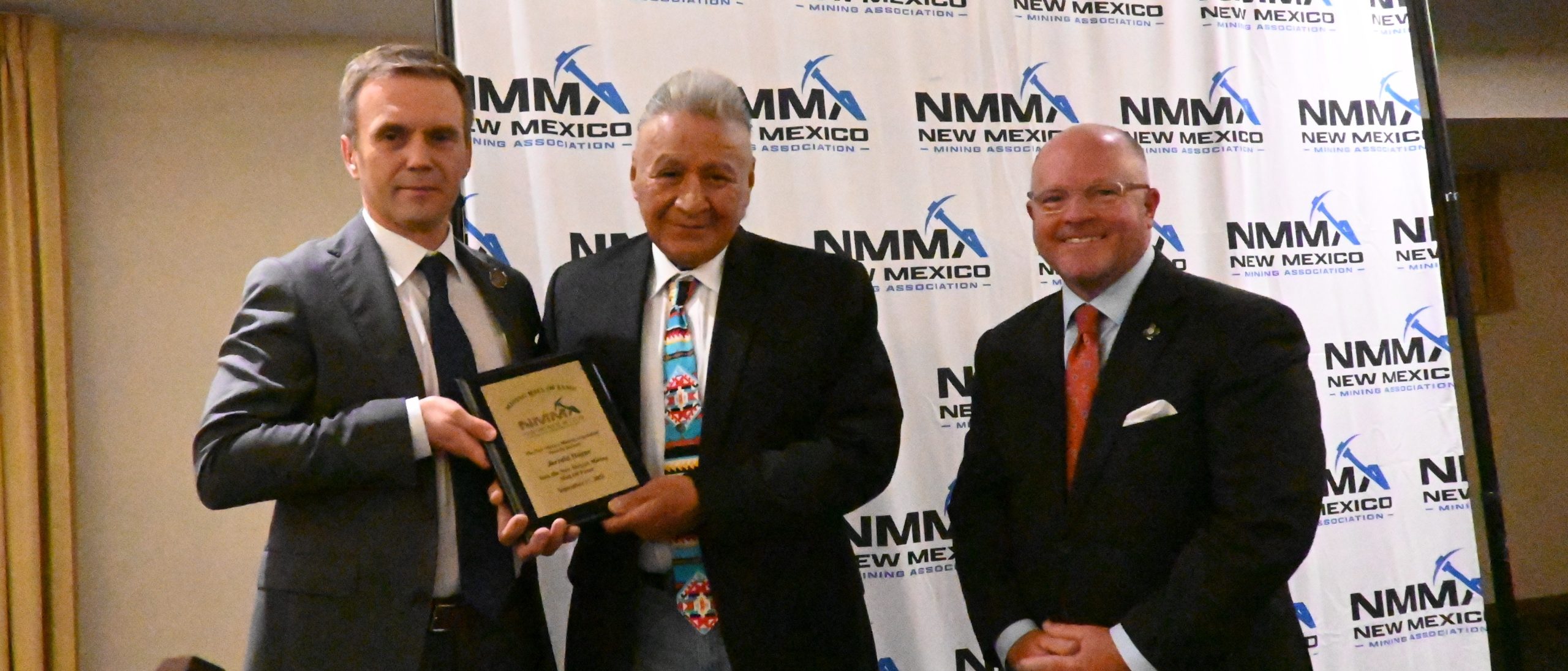
That, perhaps more than anything else, is what makes him worthy of the New Mexico Mining Hall of Fame.